
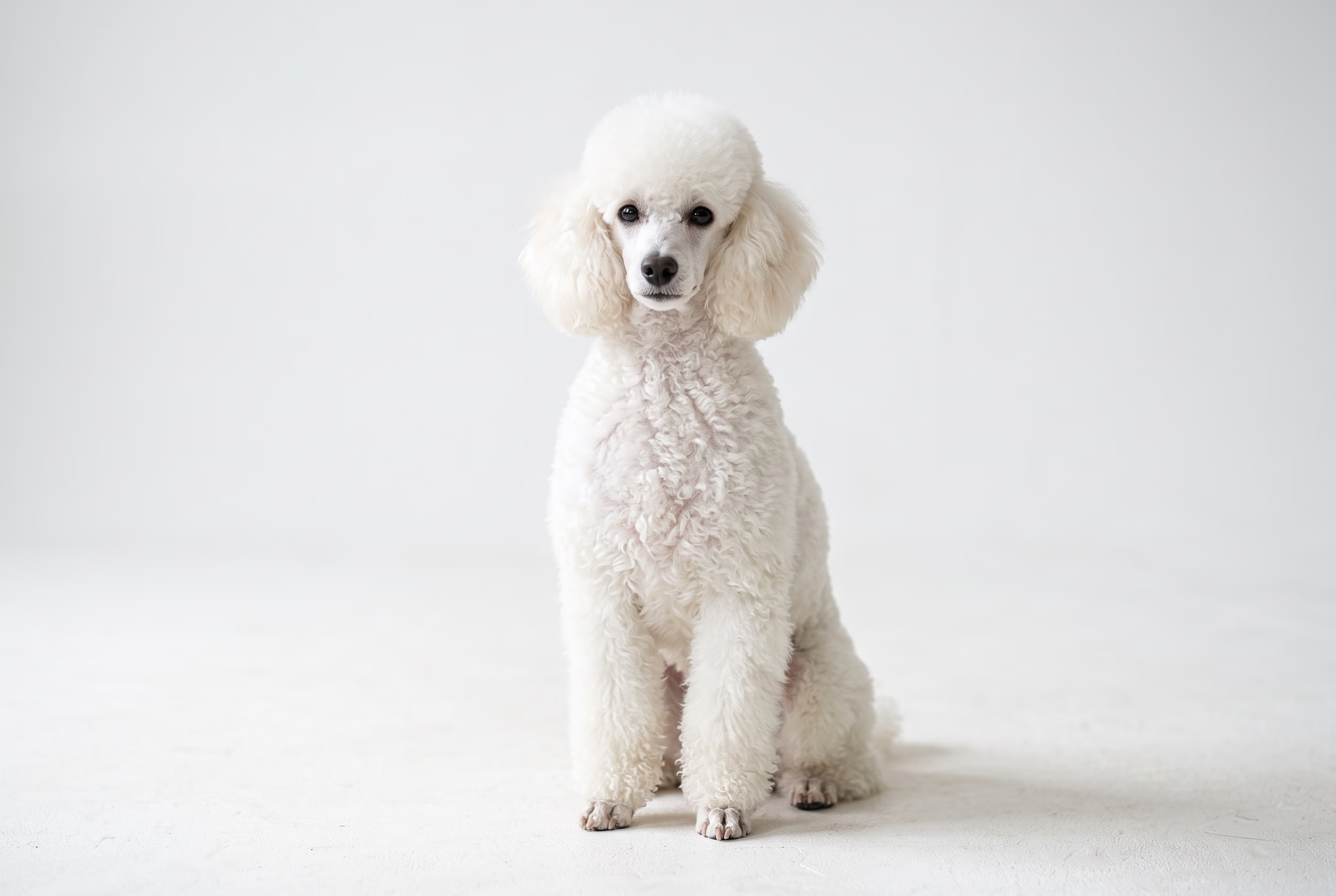
What is a Miniature Poodle?
Poodles are intelligent, people-oriented dogs with a history that includes work in water before becoming widely known as companions. Miniature is a size variety within the Poodle breed, not a separate breed. The FCI lists Standard, Medium, Miniature and Toy varieties and gives France as the breed’s country of origin. For an individual dog, confirm pedigree and registration records with the relevant registry rather than relying on a seller’s label.
Miniature Poodle size and appearance
The current FCI Miniature Poodle size is over 28 cm up to 35 cm at the withers—the point above the shoulders. It is not a body-length measurement. The standard does not prescribe a required adult weight range, so a fixed weight claim would be misleading. Assess an individual dog’s growth and body condition with a veterinarian and use verifiable records.
- The coat may be curly or corded; the standard describes a dense, woolly texture for curly coats.
- The standard names black, white, brown, grey and fawn, and also describes specified multicoloured patterns.
- A coat colour, size label or photograph cannot establish pedigree, health or future adult measurements.
Miniature vs Toy Poodle: how the standards differ
The FCI treats Miniature and Toy as varieties of the same breed, distinguished by the standard’s withers-height ranges. Toy’s lower-bound tolerance and preferred ideal height are specific to its standard description; they should not be blended into the Miniature range. A listing label or casual visual estimate is not a formal measurement.
| Variety | FCI height at the withers | Practical context |
|---|---|---|
| Miniature Poodle | Over 28 cm up to 35 cm | Consider the individual dog’s age, fitness, training and care needs separately from its size category. |
| Toy Poodle | Over 24 cm (−1 cm tolerance) up to 28 cm; ideal 25 cm | Smaller stature does not remove the need for exercise, enrichment and interaction. |
Sources
Miniature Poodle temperament and training
Poodles are often described as responsive learners, but temperament and confidence vary from dog to dog. Reward-based training, short practice sessions and patient repetition help build useful everyday skills. Introduce people, sounds, handling and new environments gradually, pairing experiences with safety and choice rather than forcing interaction.
- Reward the behaviour you want to see and avoid frightening or physically punishing the dog.
- Practise calm settling, grooming cooperation and recall as well as basic cues.
- Offer age-appropriate scent games, food puzzles and short learning activities for mental stimulation.
Exercise and family life
A daily routine can combine walks, play and opportunities to explore scents. Adjust duration and intensity for age, health, fitness and weather. Apartment living can work when the dog receives suitable movement, training and company; access to a yard alone does not meet those needs.
- Supervise interactions with children and give the dog a quiet, protected place to rest.
- Teach alone-time gradually through brief, positive experiences.
- Watch the dog’s signals and seek veterinary guidance before making major changes to exercise, especially during growth or illness.
Miniature Poodle grooming and routine care
A curly or corded Poodle coat needs ongoing attention. Brushing helps identify tangles before they become mats, but the appropriate schedule depends on coat length, clip, texture and the dog’s lifestyle. Plan professional grooming around comfort and coat condition instead of assuming one fixed interval works for every dog.
- Check ears and skin regularly. Ask a veterinarian about redness, odour, itching, soreness or discharge.
- Brush teeth regularly with dog-safe products and include oral health in veterinary check-ups.
- Keep nails at a comfortable length; ask a groomer or veterinary professional for help if needed.
- Low visible shedding does not remove allergens or make any dog guaranteed to be allergy-safe.
Nutrition and health screening
Choose food for the dog’s life stage, body condition, activity and health. Ask a veterinarian about portions, diet changes, supplements and a preventive-care schedule tailored to the individual dog.
Health tests to discuss with a breeder
The Poodle Club of America’s published recommendations for Miniature Poodles include a PRA-prcd DNA test, annual eye examination, patellar evaluation and hip-dysplasia evaluation. These are club recommendations for breeders, not universal legal requirements or a guarantee of health. A DNA test addresses the variant tested and does not rule out every eye condition or other disease. Review original records with a veterinarian and ask how results informed the parents’ breeding decisions.
Questions to ask before choosing a puppy
Choose based on welfare and verifiable information, not a promised size label or a photograph. Take time to review the puppy’s veterinary records, the parents’ health screening and the environment where the litter is raised. Arrange an independent veterinary examination before finalising an acquisition or adoption.
- Which eye, patella, hip and PRA-prcd results are available for each parent, and can the original reports be verified?
- Are dated records available for the puppy’s examinations, vaccinations and parasite prevention?
- How has the puppy been gently introduced to people, household sounds and age-appropriate daily experiences?
- Does the breeder welcome questions, show the mother and rearing conditions, and allow time to make a decision without pressure?
Sources and search guidance
The FCI standard supports the breed-variety and measurement information; the Poodle Club of America provides examples of health-screening recommendations. Google’s materials are not veterinary or breed authorities: they explain people-first content and how search features work.
Frequently asked questions
- What is the official Miniature Poodle size?
- FCI Standard No. 172 sets the height at over 28 cm up to 35 cm at the withers. This describes the variety; it does not guarantee an individual puppy’s adult size.
- How much should an adult Miniature Poodle weigh?
- The FCI standard does not set a required adult weight range. Avoid treating an unsourced number as a breed rule; ask a veterinarian to assess an individual dog’s body condition.
- Do Miniature Poodles shed?
- Shedding varies between individual dogs. Their curly coats still require regular brushing and grooming, even when loose hair is less noticeable around the home.
- Are Miniature Poodles completely suitable for people with allergies?
- No dog can be guaranteed allergy-safe. Reactions vary by person and dog; spending time with the individual dog may help inform a decision, but cannot provide a medical guarantee.
- Are Miniature Poodles good with children?
- Compatibility depends on the dog, the child and how they are introduced. Supervise every interaction, teach gentle handling and provide the dog with an undisturbed resting space.
- Can a Miniature Poodle live in an apartment?
- Yes, apartment living may suit an individual dog when daily exercise, training, enrichment and company are provided. A small home does not remove those needs.
- What grooming does a Miniature Poodle need?
- Plan regular brushing, checks for tangles and professional coat care as needed. The best interval depends on coat length, texture, clip and the dog’s comfort.
- What is the difference between Miniature and Toy Poodles?
- The FCI distinguishes them by withers height: Miniature is over 28 cm up to 35 cm; Toy is over 24 cm (with a −1 cm tolerance) up to 28 cm, with 25 cm as the ideal. Interpret measurements under the standard.
- Does a Miniature label predict a puppy’s adult height?
- No. A label alone is not a reliable adult-size guarantee. Review registry and parent records and discuss the puppy’s growth with a veterinarian.
- Does a PRA-prcd DNA test guarantee a healthy dog?
- No. It screens for a specific genetic variant and does not rule out every eye condition or other health problem. Discuss test results alongside examinations and veterinary advice.