
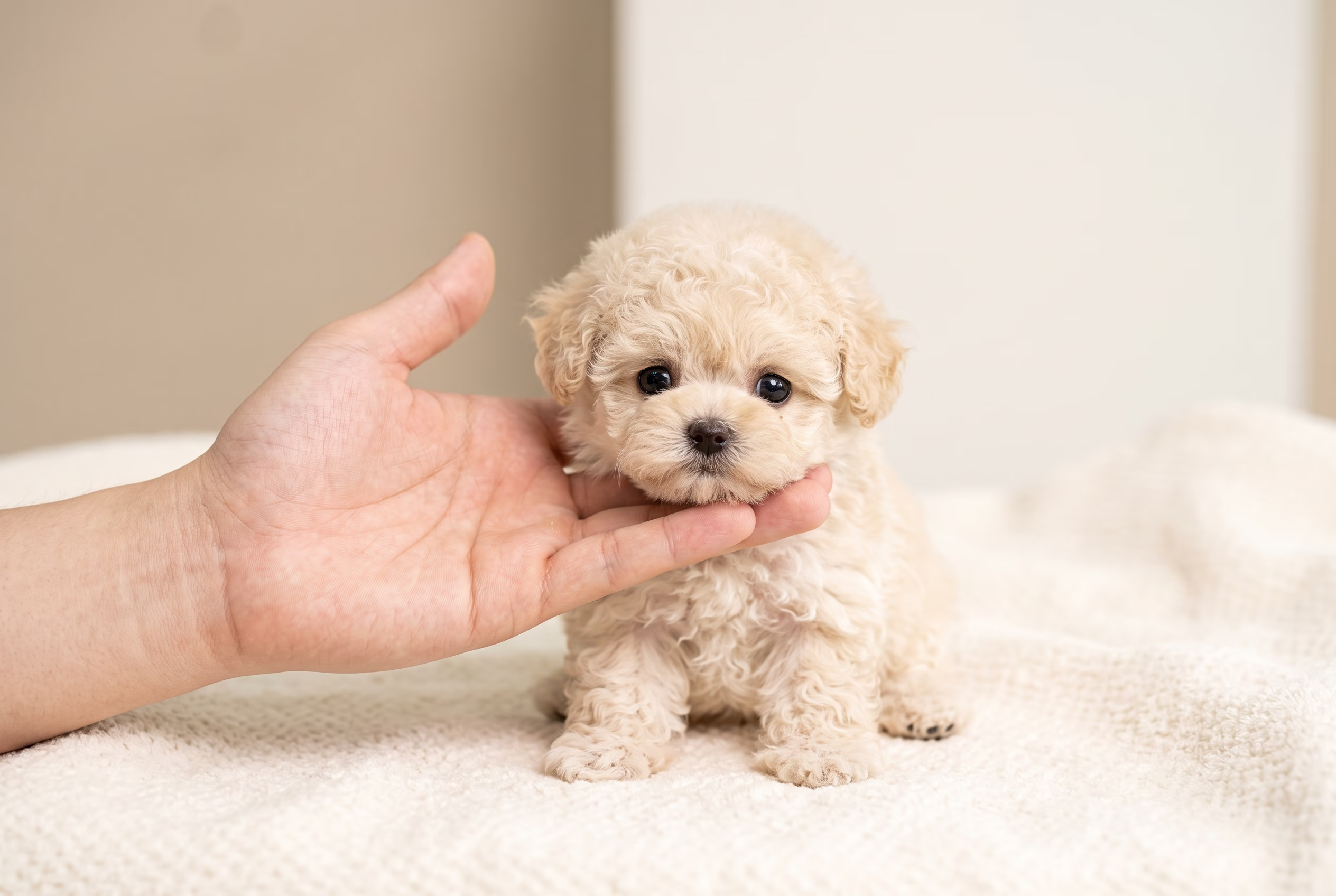
What does “Teacup Korean Poodle” mean?
The words “teacup” and “Korean Poodle” may appear in listings or everyday descriptions, but neither term establishes a dog's formal classification, ancestry or future characteristics. Ask for verifiable identity and health records, information about both parents, and an independent veterinary assessment.
Teacup vs Toy Poodle
The FCI standard describes four Poodle size varieties: Standard, Medium, Miniature and Toy. It does not list Teacup as a separate variety. Its Toy height range is over 24 cm (with a −1 cm tolerance) up to 28 cm. That is a height classification, not a weight promise, and the word “teacup” is not interchangeable with it.
A label is not registration evidence
If a seller uses Toy, Teacup or Korean Poodle, ask which registry and which measurement or pedigree document they mean. Verify the issuing organization and the dog's records rather than relying on the listing title.
How to assess adult size and weight
A puppy's eventual height or weight cannot be determined with certainty from the word “teacup.” The FCI standard classifies varieties by height; it does not promise a specific adult measurement for an individual puppy. Ask for the parents' documented measurements and the puppy's growth and veterinary records, then review development with a veterinarian.
- Treat adult-size or weight guarantees in an advertisement as claims to verify, not proof.
- Ask when and how any measurements were taken and which registry's standard is being used.
- Leave growth and body-condition assessments to regular veterinary checkups.
Health and welfare for very small puppies
Being especially small does not, by itself, establish whether a dog is healthy. The Merck Veterinary Manual notes that puppy hypoglycemia can occur in toy breeds during the first six months; this does not mean every small puppy has the same risk or a diagnosis. Contact a veterinarian promptly if you are concerned about a puppy's appetite, energy or behavior.
- Review examination, vaccination and parasite-control records, along with any test results.
- Ask a veterinarian which health screenings are relevant to the Poodle variety and the puppy's parents.
- Prioritize verifiable records and an examination over size or health guarantees.
Grooming, nutrition and veterinary care
Food amounts and meal routines depend on a puppy's age, growth and health. Discuss a feeding plan with your veterinarian, especially for a very small puppy, and do not start supplements or a special diet without their advice. Poodles have a curly or corded coat under the FCI standard, so regular brushing and grooming may be needed; plan the schedule around coat length and the individual dog with a groomer and veterinarian.
- Provide age-appropriate balanced food and water; review portions with your veterinarian.
- Plan coat, ear, eye, dental and nail care around the dog's needs.
- Follow your veterinarian's schedule for preventive care and growth checks.
Questions to ask before choosing a puppy
Look for verifiable information beyond the words used in an advertisement. If records are unclear or you are not allowed to review them, take time to investigate before making a decision.
- Can I see the puppy's and parents' identity, pedigree and registration documents, if claimed? Which organization issued them?
- Which veterinary examinations, vaccinations and parasite treatments has the puppy received, and can I review the records?
- Have the parents had health screening relevant to their Poodle variety? What were the results and dates?
- What are the puppy's birth date, growth history, daily care and socialization conditions?
- What written responsibilities does the seller accept if the puppy's health or living circumstances change?
Who may be a good fit for a very small dog?
Fit depends on the individual dog's needs and the household's routine, not its label. Consider whether you can provide regular coat care, supervision, veterinary follow-up and long-term resources. First-time owners can also prepare for these responsibilities in advance and discuss the specific puppy with an independent veterinarian.
Frequently asked questions
- Is Teacup Poodle an officially recognized FCI variety?
- No. The FCI Poodle standard lists Standard, Medium, Miniature and Toy varieties; Teacup is not a separate variety.
- Is a Teacup Poodle the same as a Toy Poodle?
- No. Toy is an FCI-defined size variety. Teacup is a listing or marketing term without a separate universal FCI size classification.
- Can a puppy's adult size be predicted exactly?
- No. A label cannot give an exact adult height or weight. Parent information and growth records can inform an assessment, which should be discussed with a veterinarian.
- Which health records should I review for a very small puppy?
- Ask for examination, vaccination and parasite-control records, any parent health screening, and pedigree or registration documents if claimed. Verify their source and review gaps with an independent veterinarian.
- Why do nutrition and veterinary follow-up matter?
- A puppy's feeding and care plan depends on its growth and individual health. Hypoglycemia can occur in toy-breed puppies, so agree on feeding routines and follow-up with a veterinarian.