What is a Standard Poodle?
The Poodle is an FCI-recognized breed in Group 9, Companion and Toy Dogs; Standard is its largest of four size varieties. The FCI standard gives France as the breed’s origin and describes an early role in wildfowling before the Poodle became popular as a companion. It is known for a balanced outline, alert expression and curly or corded coat. A standard describes the breed; it cannot predict the personality of every dog.
Standard Poodle size and the ‘Giant Poodle’ label
The official English variety name used by the FCI is Standard Poodle. “Giant Poodle” is an informal descriptive phrase sometimes used for a large Poodle; it is not a separate FCI breed or variety. The standard measures height at the withers. It does not prescribe a required adult weight range, so fixed weight claims and puppy growth predictions should be treated cautiously. Verify an individual dog’s registry records and development rather than relying on a listing title.
| FCI variety | Height at the withers | How to interpret it |
|---|---|---|
| Standard | Over 45 cm up to 60 cm; +2 cm tolerance | The standard does not set a required adult weight range. |
| Medium | Over 35 cm up to 45 cm | An official FCI variety; this site does not currently have a dedicated Medium Poodle page. |
| Miniature | Over 28 cm up to 35 cm | A distinct size variety within the Poodle breed. |
| Toy | Over 24 cm (−1 cm tolerance) up to 28 cm; ideal 25 cm | The lower-bound tolerance and ideal height are specified for Toy. |
Appearance, coat and Standard Poodle grooming
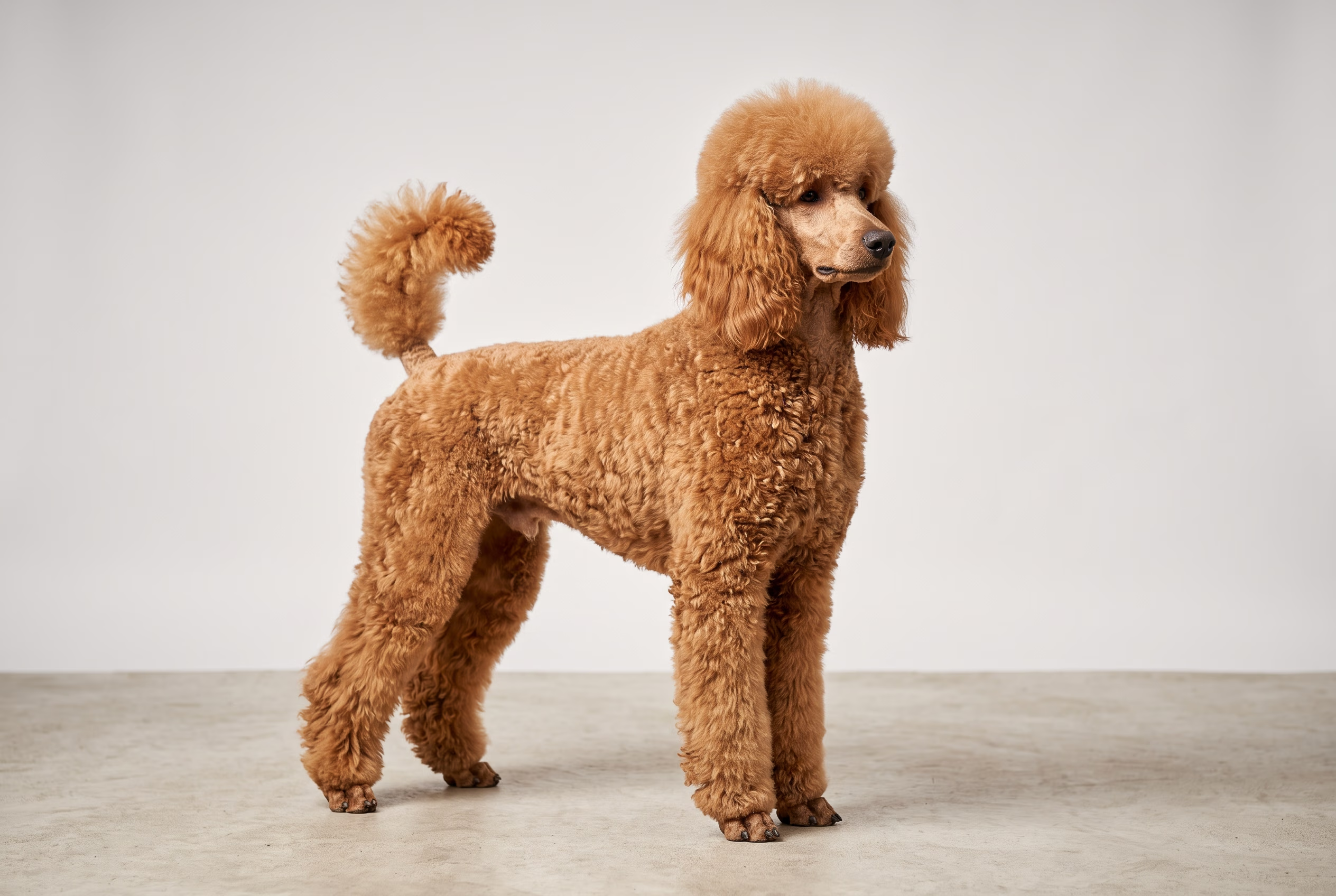
The FCI describes a harmoniously built, active dog with a curly or corded coat. Curly hair is specified as dense, fine and woolly in texture. The standard names solid black, white, brown, grey and fawn coats (from pale to red or apricot fawn), and also describes defined two-colour and multicolour patterns. Colour alone is not evidence of pedigree or health.
- Regular brushing helps find tangles before they tighten into mats.
- Professional grooming intervals depend on coat length, clip, texture, lifestyle and the dog’s comfort.
- Show-clip descriptions in the standard do not mean a particular clip is required for everyday life.
Standard Poodle temperament, learning and socialisation
The FCI standard describes the Poodle as loyal and capable of learning and training. Breed descriptions do not make every dog identical: temperament is shaped by individual traits, early experience and environment. Reward-based training, brief consistent sessions, gentle handling practice and age-appropriate mental activities can support a good start.
- Introduce people, animals, sounds and places gradually and safely.
- Use scent games, practical skills and interactive play to provide mental exercise.
- If a dog seems fearful or overwhelmed, reduce the difficulty rather than forcing exposure; seek qualified behaviour support when needed.
Exercise and everyday routines
Life with a Standard Poodle benefits from a steady mix of walks, play, training and rest. Appropriate activity depends on age, health, fitness and weather; size alone does not mean a dog is ready for strenuous or prolonged exercise. Build comfort with time alone in small, positive steps and provide predictable opportunities for interaction and mental engagement.
- Follow veterinary advice when planning activity for a growing puppy or a dog with a health condition.
- Allow safe sniffing and exploration on walks, not only distance or pace.
- Provide a quiet resting space and a consistent daily routine.
Family life and children
A Standard Poodle may fit into family life, but suitability depends on the individual dog and household. Supervise all child–dog interactions. Teach children not to disturb a dog that is sleeping or eating, and make sure the dog has a quiet place to retreat. Plan calm play and manage the dog’s size so excited movement or leash handling does not lead to accidental knocks or falls.
Routine care and nutrition
Along with coat care, check ears, teeth and nails regularly. Ask a veterinarian about odour, discharge, itching, soreness or skin changes. Brush teeth with dog-safe products and keep nails at a comfortable length. Food choice and portions depend on life stage, activity, body condition and health; set a feeding plan with veterinary guidance rather than a fixed breed-wide amount.
Health and preventive screening
Routine veterinary visits and preventive care should reflect the dog’s age, lifestyle and local risks. When speaking with a breeder, request the parents’ health records and documentation of screening. The Poodle Club of America’s health material lists hip evaluation and yearly eye examination for Standard Poodles, plus an elective health evaluation such as thyroid, sebaceous adenitis or cardiac testing. These are club screening recommendations, not a guarantee that a puppy will remain healthy or that every condition has been ruled out. Review applicable tests and original reports with a veterinarian.
- Confirm which dog was tested, the date and the original laboratory or veterinary report.
- Consider results alongside family history and clinical examinations.
- Ask a veterinarian about preventive care or any symptom in the individual dog.
Choosing a puppy responsibly
Choose on welfare and evidence, not appearance or a size promise. A responsible breeder should answer questions, share relevant records, show where the puppies are raised and allow time to decide without pressure. Review the puppy’s veterinary history and ask how it is being socialised. Arrange an independent veterinary examination before completing an acquisition or adoption.
- Which eye, hip, thyroid, heart or skin checks were recommended for the parents, and are the reports available to verify?
- Are the puppy’s dated veterinary examination, vaccination and parasite-prevention records provided?
- How is the puppy introduced to ordinary household sounds, gentle human contact and age-appropriate environments?
- What support is available if health or behaviour questions arise after the puppy goes home?
How to use the sources
The current FCI standard and breed record support the classification, measurements and description here. Health-screening examples come from Poodle Club of America materials. Google’s guides are not canine health authorities; they offer general guidance on people-first content and search features.
Frequently asked questions
- What is the official Standard Poodle size?
- FCI Standard No. 172 gives a height over 45 cm up to 60 cm, with a +2 cm tolerance. It is measured at the withers.
- How much does an adult Standard Poodle weigh?
- The FCI standard does not set a required adult weight range. Assess an individual dog’s body condition with a veterinarian rather than relying on a fixed figure.
- What is a Standard Poodle’s temperament like?
- The standard describes Poodles as loyal and capable of learning and training. An individual dog’s temperament also depends on experience, socialisation and environment.
- Do Standard Poodles shed a lot?
- Shedding varies between dogs. Their curly or corded coat still needs regular brushing and grooming even when loose hair is less noticeable.
- What grooming does a Standard Poodle need?
- Plan regular coat checks and brushing, professional coat care as needed, and routine attention to ears, teeth and nails. The appropriate schedule varies by dog and coat.
- How much exercise does a Standard Poodle need?
- Provide a regular mix of walks, play, training and rest, adjusting activity for age, health and fitness. There is no single duration that fits every dog.
- Can a Standard Poodle live with children?
- It can work when the individual dog and household are a good match. Supervise interactions, teach respectful handling and give the dog a protected resting place.
- Is ‘Giant Poodle’ a separate breed?
- No. ‘Giant Poodle’ is an informal descriptive label sometimes used for a Standard Poodle; it is not a separate FCI breed or variety.
- How does Standard differ from Toy or Miniature Poodle?
- The FCI distinguishes varieties by withers height. Standard is over 45–60 cm (+2 cm tolerance); Miniature is over 28–35 cm; Toy is over 24 cm (−1 cm tolerance) up to 28 cm, with 25 cm ideal.
- Do health-screening results guarantee a healthy puppy?
- No. Screening can inform breeding decisions about specific risks, but cannot eliminate every condition or guarantee an individual dog’s future health.