
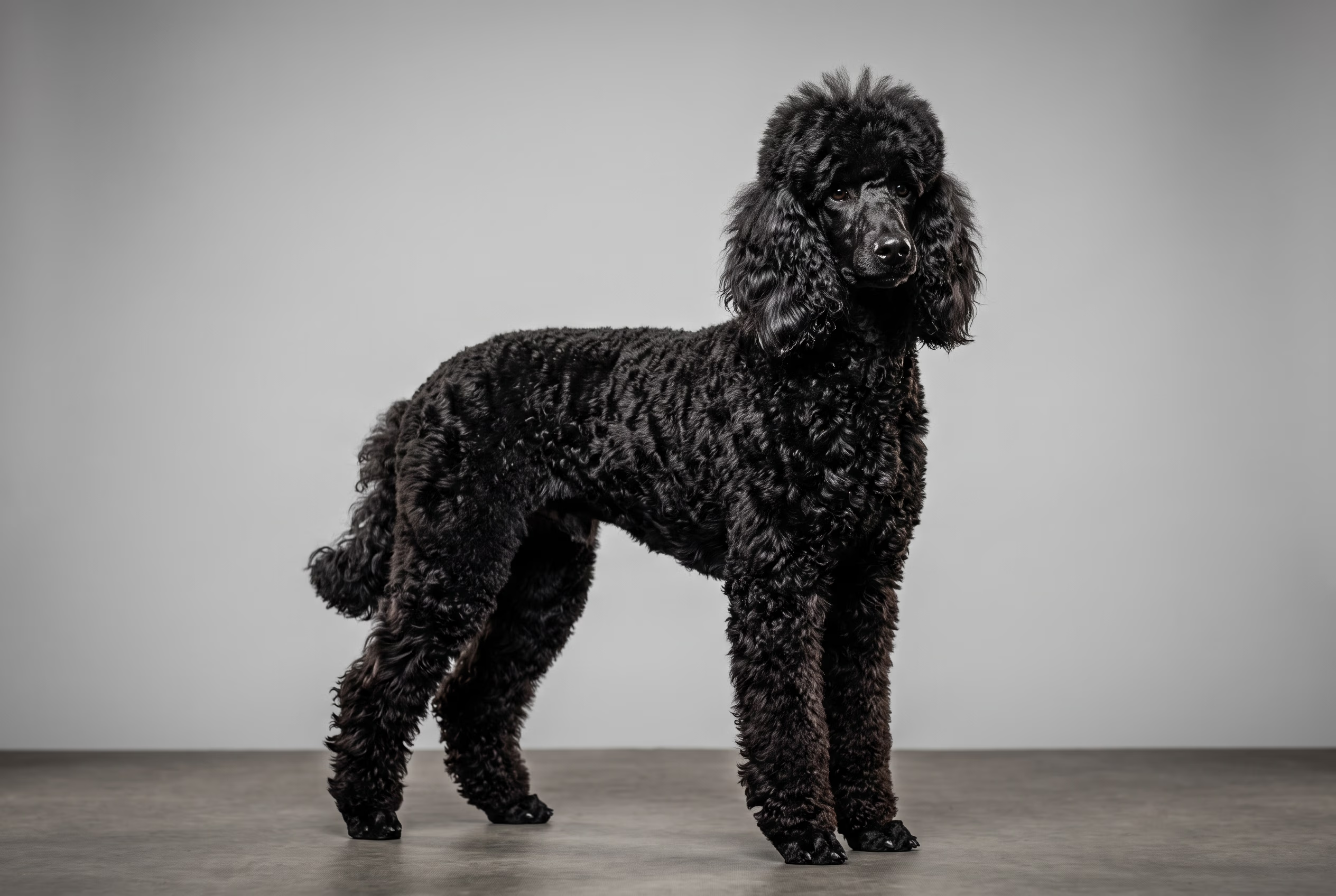
What is a Poodle? Origin and general appearance
The FCI lists France as the breed’s country of origin and places the Poodle in its Companion and Toy Dogs group. Its standard’s historical summary says Poodles were originally used for wildfowling and links their history to the Barbet before the breeds were gradually separated. The current standard describes a harmoniously built, alert dog with a curly or corded coat. Historical descriptions do not predict the background or temperament of an individual dog.
Poodle sizes in the FCI standard
The measurements in FCI Standard No. 172 refer to height at the withers. Standard Poodles have a +2 cm tolerance at the upper end; Toy Poodles have a −1 cm tolerance at the lower end and an ideal height of 25 cm. The standard does not publish a separate adult weight range. Size categories used by other registries may differ, so avoid mixing measurement systems.
| FCI variety | Height at the withers | General living and care consideration |
|---|---|---|
| Standard Poodle | Over 45 cm–60 cm; +2 cm tolerance | Plan suitable equipment and safe movement space for a larger frame; activity needs vary by individual. |
| Medium Poodle | Over 35 cm–45 cm | Size alone does not determine temperament, exercise or grooming needs. |
| Miniature Poodle | Over 28 cm–35 cm | Assess daily training, activity and coat care for the individual dog. |
| Toy Poodle | Over 24 cm (−1 cm tolerance)–28 cm; ideal 25 cm | Use careful handling and supervised interaction suited to a small frame; small size does not remove care needs. |
Coat, appearance and colors
The FCI describes the Poodle coat as curly or corded. Its 2024 standard lists black, white, brown, grey and fawn shades (from pale fawn through red and apricot) under solid colors, and also describes multicolored patterns. A coat color or clip does not by itself verify a dog’s registration category or health. Dense coat needs regular checks, brushing and a grooming routine suited to the individual dog.
- Check and brush the coat gently; do not pull at matted areas.
- Care intervals depend on coat length, clip and the dog’s skin and coat condition.
- Ask a veterinarian about suitable ear, nail and dental care.
Temperament, learning and socialization
The FCI standard describes the Poodle as loyal and capable of learning and training. A breed description cannot predict every dog: temperament, experience, age, health and learning history all matter. Reward-based methods, calm consistency and age-appropriate socialization help build everyday skills.
- Teach foundational skills in short, clear, reward-based sessions.
- Introduce people, sounds, surfaces and other animals gradually, paying attention to the dog’s comfort.
- Make room for both mental enrichment and rest in the daily routine.
Exercise, home life and time alone
A Poodle’s activity needs cannot be decided from its size label alone. Provide walks, play and training suited to the dog’s age, health and individual energy. Apartment fit also depends on responses to sound, toilet routines, daily time and the building environment. Build comfort with time alone gradually in a safe setting.
- Adapt activity to age and health, and allow rest when the dog seems tired or uncomfortable.
- Supervise calm introductions to children and other animals.
- Provide a quiet place where the dog can rest undisturbed.
Poodle grooming and everyday care
Poodle care is more than a haircut. It includes coat checks and brushing, ear and nail care, dental hygiene, balanced feeding and veterinary follow-up. Professional grooming intervals are not identical for every dog; plan them around the coat and the dog’s comfort.
- Set a brushing and clipping routine suited to coat texture and length.
- Ask a veterinarian for feeding advice based on age and body condition.
- Follow local veterinary guidance for vaccination, parasite prevention and preventive examinations.
Health, veterinary care and responsible selection
Health considerations can vary by Poodle variety and individual dog. The Poodle Club of America’s health resource collects information about conditions affecting Poodles and variety-specific screening guidance. Ask for verifiable parental test records, then discuss which screening is appropriate with an independent veterinarian. A test does not rule out every condition or guarantee a puppy’s future health.
- Review current veterinary examination, vaccination and parasite-treatment records for the puppy.
- Ask for the parents’ identities and which health tests were performed, by whom and when.
- Learn about the puppy’s environment and age-appropriate, safe social experiences.
- Be cautious if records are withheld, questions are dismissed or you are pressured to decide quickly.
Official varieties and site labels are different
FCI Standard No. 172 names four varieties: Standard, Medium, Miniature and Toy. “Korean Poodle,” “Teacup” and “Micro” are not separate varieties in that list. On this site those terms help identify related informational pages; they should not be treated as proof of registration, pedigree or adult size.
- About the Korean Poodle label
- About the Teacup Korean Poodle term
- About the Micro Poodle term
- About the Toy Poodle variety
Sources
Sources
These references support the classification, measurements, health and content guidance used in this overview:
Frequently asked questions
- Which Poodle sizes are officially listed by the FCI?
- FCI Standard No. 172 lists Standard, Medium, Miniature and Toy varieties. Their withers-height ranges are shown in the comparison table.
- Does the FCI standard give an adult weight range for each variety?
- The standard distinguishes the varieties by height at the withers and does not provide a separate adult weight range. This guide therefore does not invent one.
- What is the difference between Toy and Miniature Poodles?
- The FCI size ranges differ: Toy is over 24 cm, with a 1 cm lower tolerance, up to 28 cm and an ideal of 25 cm; Miniature is over 28 cm up to 35 cm.
- Do Poodles shed?
- The FCI describes the coat as curly or corded, but this does not mean every dog sheds identically. Coat length and grooming also affect its appearance.
- Are Poodles suitable for everyone with allergies?
- No breed can guarantee an allergy-free experience. If allergies are a concern, discuss it with a health professional and consider your individual circumstances.
- Can a Poodle live in an apartment?
- It may, depending on the dog’s activity, training, response to sounds, toilet routine and plan for time alone, as well as the household and building.
- Are Poodles good with children, and how much exercise do they need?
- Compatibility and activity needs vary with the individual dog, age and health. Supervise interactions with children and plan activity around the dog rather than the variety name alone.
- What does Poodle grooming involve?
- It includes coat checks and brushing, professional grooming suited to coat length, and regular attention to ears, nails and teeth. The routine varies by dog.
- What records should I ask for when choosing a Poodle puppy?
- Ask for the puppy’s veterinary, vaccination and parasite records and verifiable health-test records for the parents. Learn about the puppy’s environment and review screening choices with a veterinarian.
- Is Korean Poodle an official FCI variety?
- The FCI lists Standard, Medium, Miniature and Toy Poodles. “Korean Poodle” is not listed as a separate official variety.